

The Haunted World: Eastern State Penitentiary
Welcome to Field Notes from the Beyond!
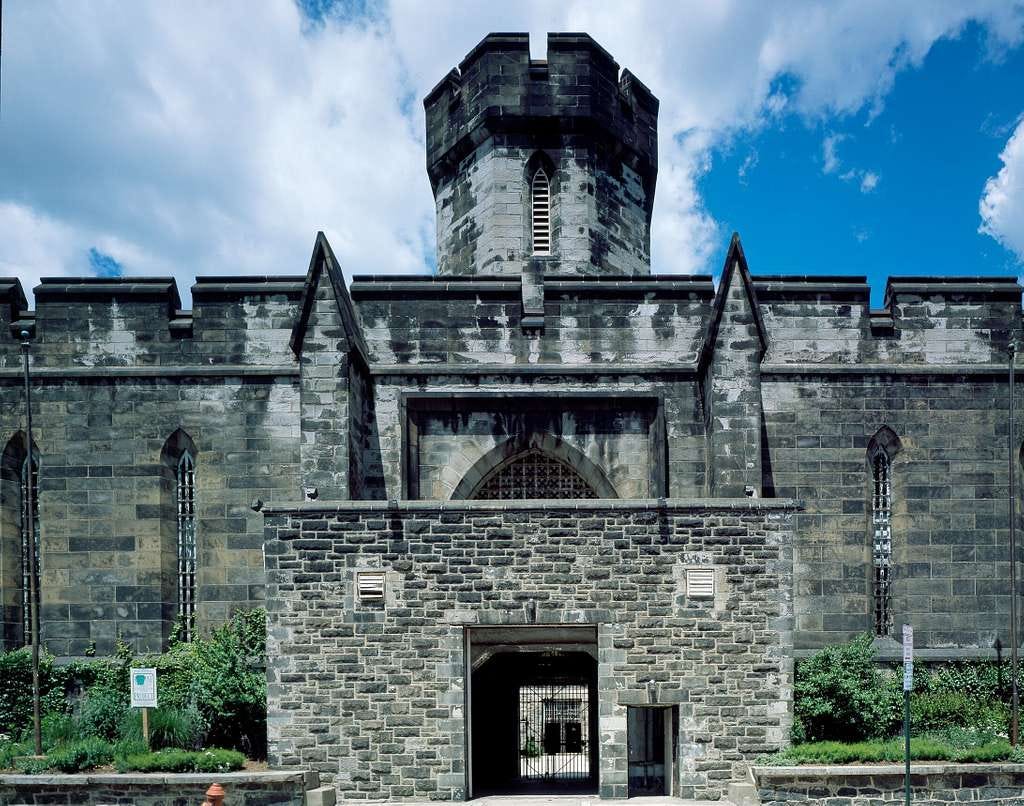
Eastern State Penitentiary is an imposing structure located at 2027 Fairmount Avenue in the Fairmount neighborhood of Philadelphia, Pennsylvania. This site was intentionally chosen for its elevated, then-isolated position northwest of the city center. This detachment was thought to promote healthy air for the inmates, while simultaneously removing the criminal element from the sight of the general public. Today, it sits in the middle of the city, surrounded by homes and businesses. Philadelphia is quite a bit larger than it was in the 1820s!
Construction began on the prison in 1822; it opened its doors in 1829 and was continuously used through 1971. It takes up a full city block and is surrounded by 30-foot-high granite perimeter walls that are 12 feet thick at the base, tapering to 2.75 feet thick at the top. It has a castle-like face in a Gothic Revival architectural style with massive towers at each of the four corners. There is large gatehouse in the center of the southern façade.
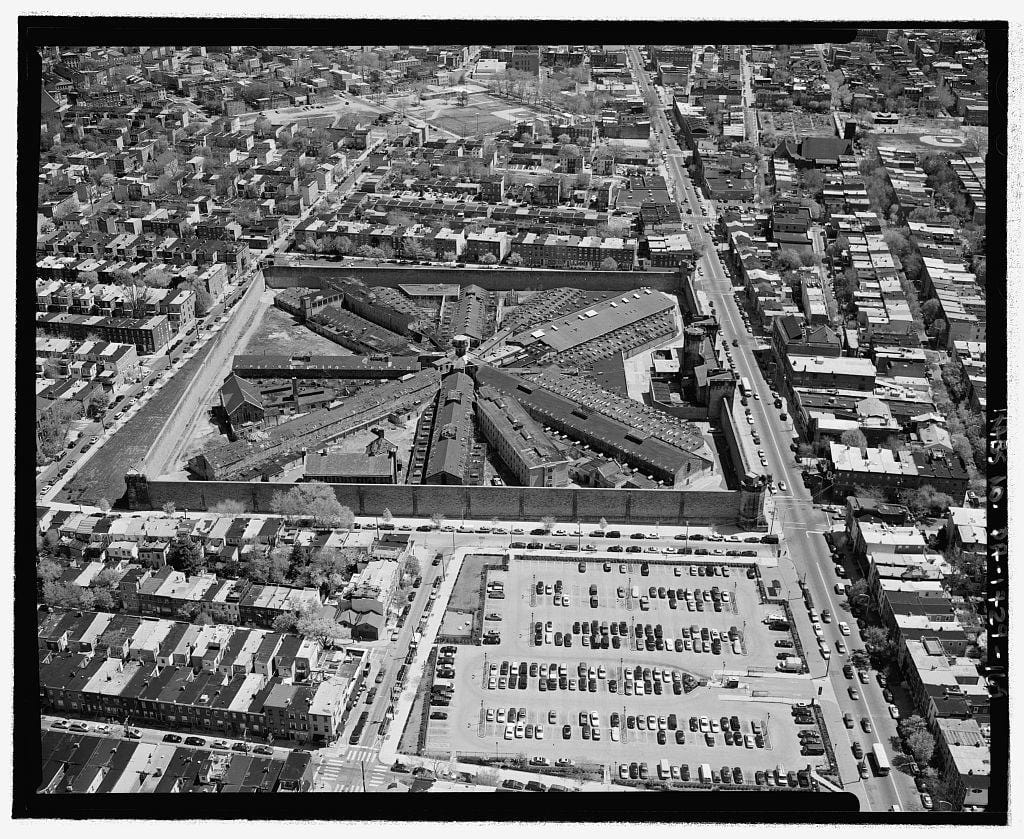
The architect, John Haviland, pioneered a radical new design known as the “wagon wheel” or radial plan. This layout featured seven one-story cellblocks radiating out from a central hub. From this central rotunda, a single guard could theoretically observe the entrance of all seven cellblocks. This design was incredibly influential, serving as a model for over 300 prisons worldwide.
Each original cell included features that were considered luxurious for the 1820s, including central heating, a flushing toilet, running water, and even a small, private outdoor exercise yard. The most symbolic feature, however, was a small skylight in each cell’s ceiling, referred to by some as the “Eye of God.” This was the only source of natural light, and it served as a constant reminder that, even in isolation, the inmate was under the perpetual, silent gaze of a higher power.
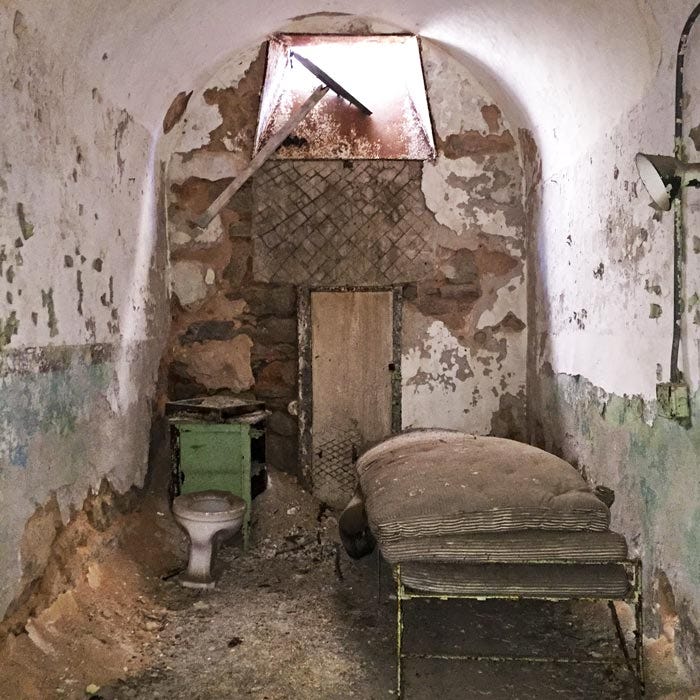
Today, the structure is maintained as a “stabilized ruin.” This means that it has not been fully restored, but rather left in a state of decay. It is crumbling in some areas and has a lot of peeling paint and rust. This lack of repair definitely adds to the atmosphere!
The Pennsylvania or Separate System
Eastern State Penitentiary was considered revolutionary in the prison systems of the time. It created the “Pennsylvania System” or “Separate System”, which was different from the previous penal model where inmates were held together in communal jails that were often over-crowded, violent, and full of infectious diseases.
The reformers of the time, many of whom were Quakers, believed that public and corporal punishment was inhumane. Instead, they theorized that the ultimate means of reform was through solitary confinement. The entire design of Eastern State ensured that prisoners spent 23 hours a day in complete isolation and absolute silence. The idea behind the design was that this separation would force the criminal to reflect on their crimes, repent, and achieve true penitence. Hence, the term “penitentiary.”
Key aspects of the Separate System included:
Total Isolation: Inmates ate, slept, and worked (light labor in their cells) completely alone. They were not allowed to see or speak to any other inmate.
Hooded Movement: Whenever a prisoner was moved from their cell, they were hooded to prevent any chance of visual or verbal communication.
Limited Contact: The only human contact was with a warden or overseer, whose interactions were intended to be brief and purely administrative. The only book permitted was the Bible.
This system of “reform” quickly became very controversial. Its creators and some visitors, notably French diplomat, historian, and philosopher Alexis de Tocqueville, praised it. Tocqueville believed that the isolation and despair generated by it would re-shape prisoners’ minds and change them in positive ways. He wrote about it in his report On the Penitentiary System in the United States and Its Application to France, and later in his famous Democracy in America.


Critics, including author Charles Dickens who visited in 1842, were horrified by the psychological toll. In his book criticizing solitary confinement, American Notes, Dickens stated, “I hold this slow and daily tampering with the mysteries of the brain to be immeasurably worse than any torture of the body.” This perspective has been backed by significant research today. Prolonged solitary confinement is now considered a form of torture that can lead to depression, anxiety, hallucinations, and irreversible changes in the brain’s structure and function. I guess that means de Tocqueville was correct in that it changed prisoners’ minds, just not in the positive ways he believed.
By the mid-19th century, the system was demonstrably failing. I know, shocking, right?! (Read sarcastically, please.) Overcrowding, mental illness, and brutal incidents such as the 1833 death of a prisoner subjected to the torturous “iron gag” for speaking forced officials to relax the rules. If you are unfamiliar with this particular device it was a contraption that forced a person’s mouth open, often with a spiked bit that would lacerate the tongue if the person tried to speak. There were many different versions of it, but all were pretty brutal. The policy of absolute solitary confinement was formally abandoned in 1913, transitioning the facility to a congregate prison.
Eastern State was home to approximately 85,000 inmates before its closure. Its most famous residents include Alphonse “Al” Capone and Willie Sutton. Capone served an eight-month sentence for carrying a concealed weapon in 1929. His cell was a bit different from others; it was luxurious in many ways. Take a look at the picture below. It remains decorated for visitors.


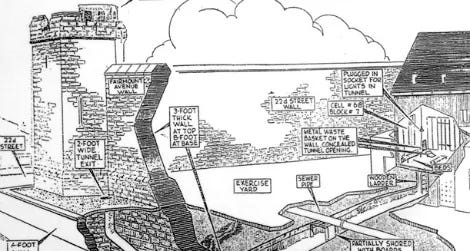
The notorious bank robber, “Slick Willie,” escaped on April 3, 1945, along with eleven others via a tunnel they dug. Sutton was apprehended the same day after running into a police officer only two blocks from the prison. All 12 escapees were recaptured within hours to days of the escape. This was Sutton’s fifth attempted escape from Eastern State and he was subsequently transferred to Holmesburg Prison. In 1947, he escaped Holmesburg and was recaptured five years later in 1952.
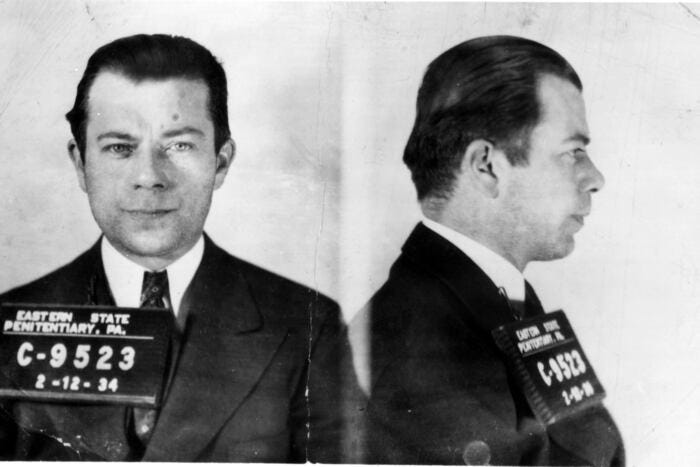
The facility continued operations until 1971, when it was officially closed by the State of Pennsylvania due to aging infrastructure, overcrowding, and rising costs. After its closure, it sat abandoned for over two decades, falling into a state of decay, until preservation efforts led to its opening as a historic site on today’s date (October 15) in 1994.
Haunted Eastern State Penitentiary
Eastern State Penitentiary is widely regarded as one of the most haunted locations in the United States. Reports of paranormal activity include some general phenomena, such as shadow figures, disembodied voices, intense feelings, and things moving on their own, as well as a few very specific sightings.
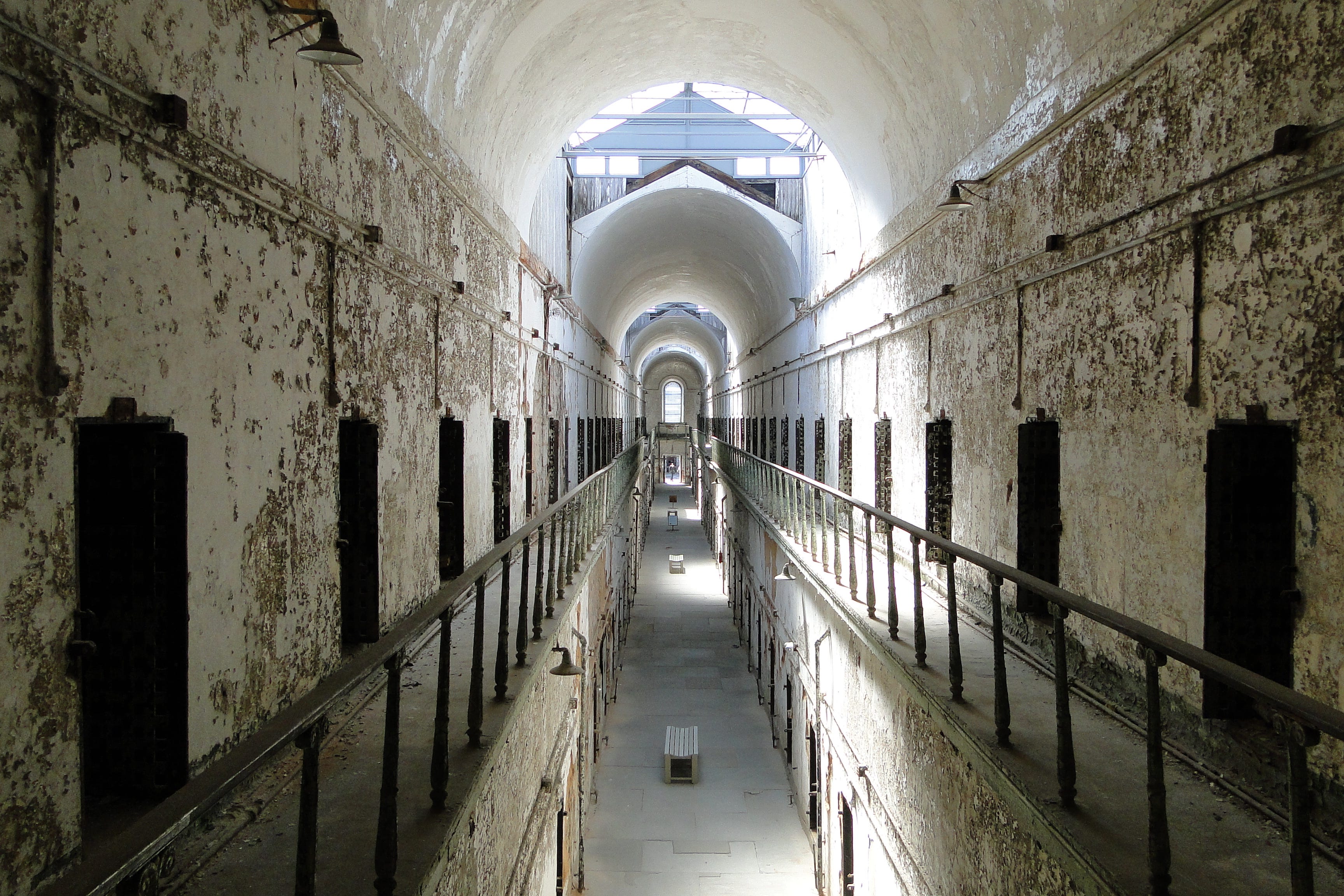
Shadow Figures and Apparitions: The most common reports of paranormal activity involve people seeing shadow figures throughout the cellblocks and corridors, but particularly in cellblocks 6 and 12. Another common account involves a dark figure seen standing motionless at the top of one of the guard towers, then disappearing. A female apparition wearing white, nicknamed “The Soap Lady,” is frequently reported in the last cell on the second floor where the women’s cellblock was located.
Disembodied Voices and Sounds: Cellblock 12 is known as a hotspot for disembodied voices, described as whispering, quiet conversations, crying, and even loud cackling laughter. Visitors and staff also have reported hearing inexplicable screams and the sound of frantic footsteps in many other areas of the penitentiary.
Intense Feelings: Many people report intense and oppressive or threatening feelings all over the site, but particularly from Death Row and sites of physical torture. If you are unfamiliar with the physical things an inmate may have had to endure, here are a few examples.
Doctors at the time believed that mental illness spread through the body via blood circulation. Thus, curing it involved restricting movement so that the blood couldn’t pump through the body properly. The Mad Chair was used to accomplish this. It allowed inmates to be strapped down so that they couldn’t move. They would stay there for days without food. After this “treatment” many inmates had limbs amputated.
A particularly brutal punishment was used for prisoners who broke the rules during the winter. Known as the ice bath or water bath, guards would throw cold water on prisoners and then chain them to an exterior wall of the prison. They remained there overnight or until all of the moisture on their skin froze. Not everyone survived this punishment.
In the early 1990s, a maintenance worker in Cellblock 4 reported being overcome by an overwhelming sense of dread and saw tormented faces materialize on the cell walls, followed by an aggressive shadow figure that came towards him from across the cellblock. The worker also claimed to have been physically restrained by something while working on a lock.
Al Capone’s Cell: During his eight-month stay, Al Capone reportedly suffered from night terrors, screaming and begging an unseen presence to leave him alone, calling out the name “Jimmy”. The name is believed to refer to James Clark, one of Capone’s victims from the infamous St. Valentine’s Day Massacre. The ghost of Jimmy reportedly followed Capone the rest of his life, tormenting him. He even hired medium Alice Britt to try to communicate with Jimmy to find out what he wanted; she was unsuccessful. It is unclear if the cell was ever haunted during Capone’s time here, particularly given that he was later diagnosed as having neurosyphilis and may have had it at the time. Regardless, paranormal investigators and visitors to his old cell have reported an inexplicable feeling of dread and some paranormal activity.

Pep the Ghost Dog: Pep was a black Labrador retriever who was used as a therapy dog with the intent of boosting inmate morale. There is a prison legend that he killed the Pennsylvania governor’s cat and was subsequently given a life sentence in Eastern State, with inmate number C-2559. Visitors say they can hear Pep’s dog tags jangling and the sound of him running through the corridors howling.
Other Activity: Many paranormal groups investigating the prison have documented objects moving on their own and unexplained equipment malfunctions. There are also standard reports of communication with spirits through all the usual equipment. Overall, a significant amount of paranormal activity is reported.
We’ve never been to Eastern State Penitentiary, even though we live in Pennsylvania! We moved here after they stopped allowing investigations. We’re hopeful they will start letting people in one day because we would love to go. Maybe we’ll have to be satisfied with going on one of their history tours!
References & For More Information
Beaumont, G. de, & Tocqueville, A. de. (2018). On the penitentiary system in the United States: and its application in France (E. Ferkaluk, Trans.). Palgrave Macmillan.
Dickens, Charles, 1812-1870. American notes for general circulation. London : Chapman and Hall, 1842.
Tocqueville, A. (2002). Democracy in America (H. C. Mansfield Jr. & D. Winthrop, Trans.). University of Chicago Press.
https://ghostcitytours.com/philadelphia/haunted-philadelphia/eastern-state-penitentiary/
https://fairweatherlewis.wordpress.com/2013/02/14/the-haunting-of-al-capone/
https://www.discoverphl.com/partners/eastern-state-penitentiary-historic-site/
Coming Up Next
Next in Field Notes from the Beyond: Another installment of Defining the Paranormal!
This Month on Beyond the Human: The Medical Mystery known as Morgellons Disease
This Month on Beyond the Human: The Culture of Ghost Hunting
Next Month on Beyond the Human: Death & the Afterlife
Who are we?
We are a group of scholars interested in understanding paranormal, supernatural, and anomalous phenomena from an academic perspective. We want to document and validate experiences people have and study them in a rigorous way to bring credibility to these phenomena. Join us for our monthly podcast Beyond the Human and follow us on Spotify, Instagram, and Patreon to learn more about who we are, our methods, and what we want to learn!