

Cryptid Compendium: Caddy

Welcome to Field Notes from the Beyond!
For centuries, there have been accounts of a large sea creature off the coastlines of the Pacific Northwest. One of the most thoroughly documented cryptids in modern history, this animal was given a name in 1933 by Archie H. Wills, a journalist and editor at the Victoria Daily Times in British Columbia, Canada. Cadborosaurus or Caddy for short, is named for its primary area of sightings, Cadboro Bay, Victoria, British Columbia, combined with the Greek root saurus, meaning “lizard” or “reptile” and (obviously) reminiscent of dinosaurs. In 1995, marine biologist Dr. Edward L. Blousfield and paleontologist Dr. Paul H. LeBlond provided a formal Linnaean binomial: Cadborosaurus willsi, honoring Mr. Wills.

Physical Description
There have been more than three hundred distinct accounts of Caddy, spanning two centuries. There is a striking internal consistency in physical description, though it is a strange combination of mammalian, reptilian, and fish characteristics. The specificity of the descriptions is unusual for witnesses to many cryptids.
Adults of the species are consistently described as exceptionally long and slender. Estimated lengths range from 15 feet (4.5 meters) for younger individuals to 40 or even 70 feet (12 to 21 meters) for fully mature adults. Despite this length, the diameter of the trunk is reported as narrow, rarely exceeding 2 to 4 feet (0.6 to 1.2 meters). This gives the animal a serpentine appearance and mode of locomotion. The estimated mass of a full-grown 60-foot C. willsi thus approaches roughly 5500 to 6600 pounds (2.5 to 3 metric tons).
The head is probably the most distinctive part of Caddy. Witnesses consistently describe the head as camel-like, horse-like, or resembling a large hound. The snout is elongated and slightly squared, featuring prominent nostrils that seal shut when submerged. The eyes are exceptionally large, dark, and set forward on the skull. Some accounts explicitly state the eyes appear to “open from top to bottom” or possess a highly reflective tapetum lucidum like a cat’s eyes have, adapting them for hunting in the dark.
Many accounts note the presence of short, stubby, ear-like protrusions or small, paired “horns” on the skull. The head itself rests on a long, flexible neck that can measure anywhere from 3 to 8 feet (0.9 to 2.4 meters) in length. This allows Caddy to elevate its head out of the water to scan its surroundings.
The body is characterized by its capacity to flex along its vertical axis. Unlike true terrestrial snakes, who move via lateral or side-to-side undulations, Caddy moves through vertical or up-and-down undulations. When swimming rapidly at or near the surface, the trunk kinks into a series of two to three prominent, vertical humps or loops in tandem behind the neck. These appear to the naked eye like a row of giant, dark inner tubes bobbing through the water.
There is some debate about the skin texture. Many witnesses describe a sparse coat of short, brownish, dark green, or slate-gray hair or “ruffles” along its neck and upper spine. Others accounts note a distinctly wrinkled, scaly, or serrated ridge of dermal tissue running down the dorsal midline.
A pair of broad, paddle-like flippers is situated low on the torso just behind the base of the neck, probably used for steering, stabilization, and/or low-speed maneuvering. The tail end of Caddy is unique. Rather than tapering to a simple point, the hind limbs appear to be laterally compressed and webbed into the tail, forming a broad, horizontal, forked caudal fluke. This structure, sometimes described as looking like a “pair of giant hands held flat” or a split whale fluke with a central series of vertebral knobs, provides vertical thrust. As one would expect, Caddy is an exceptionally rapid swimmer. It is described as cruising at 3 to 5 knots, but capable of bursts of speed between 25 and 30 knots. Diet and Foraging Strategy
Caddy is clearly an apex predator. Witness accounts describe the animal pursuing schooling fish, such as Pacific salmon, herring, and rockfish. Caddy also exhibits surface avian predation. Several accounts involve the creature rising unexpectedly into flocks of resting coastal birds.
Habitat and Seasonal Migration
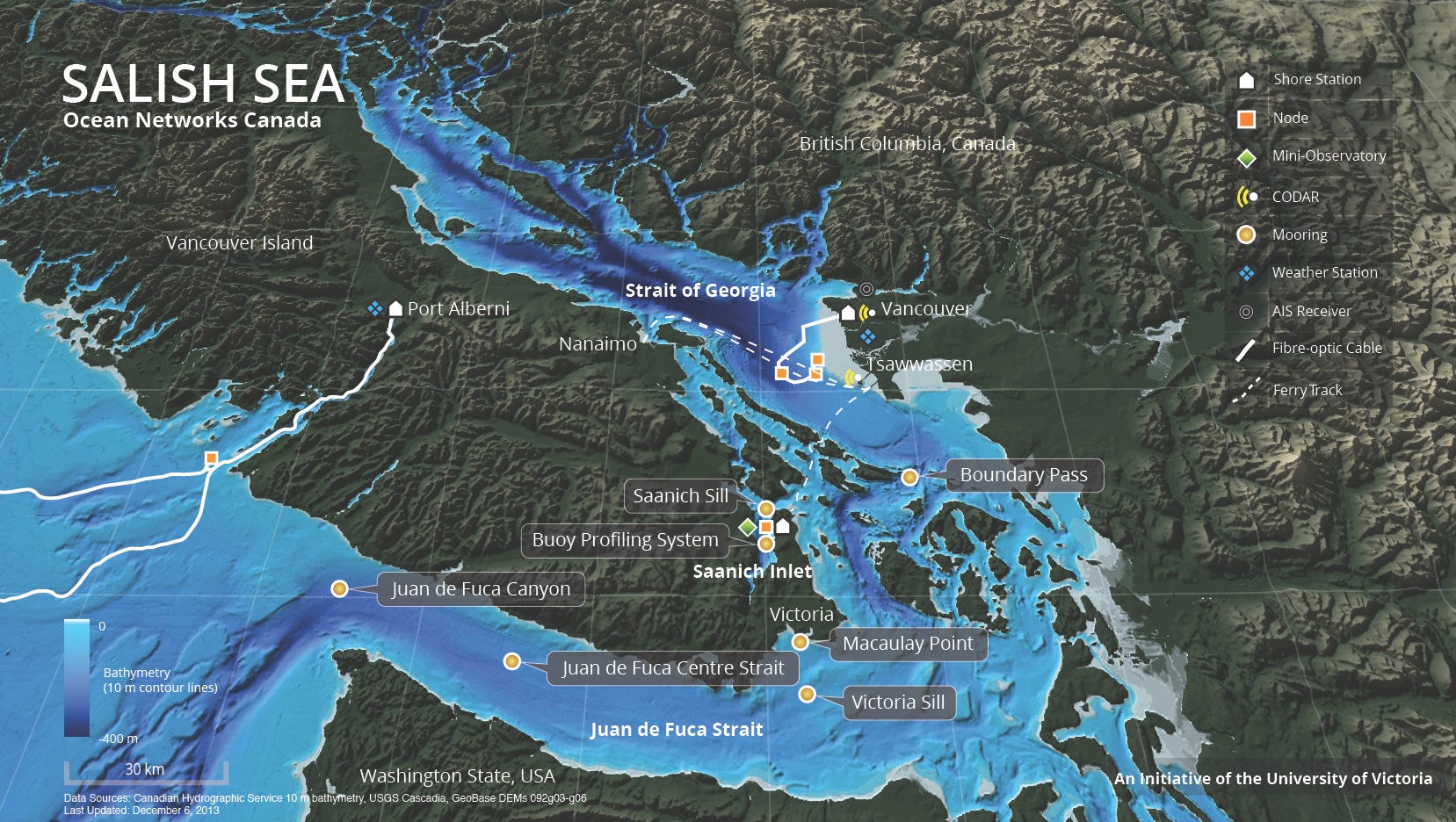
The core range of Caddy appears centered within the inland sea networks of the Salish Sea, where deep, cold glacial trenches are surrounded by shallow reefs and estuaries. However, there also seems to be a seasonal migration pattern. During the late autumn and winter months, sightings drop significantly, suggesting the animals retreat into the open Pacific or migrate north toward the Gulf of Alaska. As spring arrives and water temperatures rise, they return to the protected inland straits, possibly following the seasonal salmon runs or maybe giving birth in the isolated fjords.

Earliest Sightings
First Nations peoples of the Pacific coast recorded the presence of a large sea creature in their oral histories, physical art, and spiritual traditions. To many different tribes, Caddy is physically flesh and blood and sometimes dangerous.
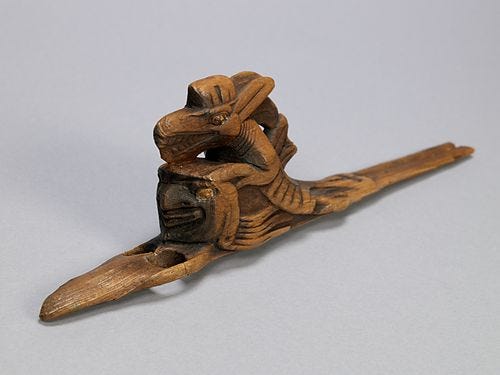
Ancient petroglyphs carved into the sandstone cliffs of Vancouver Island, such as those documented at the Monsell site near the Nanaimo River, depict an elongated, marine animal featuring distinct humps, a stylized head, and terminal flippers. An intact atlatl (wooden spear-thrower) recovered from the mud of the Skagit River in Washington State, dated about 1800 years ago, is carved into the likeness of a serpentine creature with a prominent, mammalian or reptilian snout and an undulating spine, aligning with the physical profiles of Caddy.
Major Sightings in the 20th Century
The Philpott Account (1932)
One of the earliest, most reliable accounts occurred near Discovery Island. F. W. Philpott, a navigator accustomed to identifying whales, porpoises, and sea lions, observed a huge, snake-like animal swimming less than one hundred yards from his vessel. Philpott noted that the creature elevated a horse-like head fully four feet out of the water, revealing a thick, muscular neck and a series of dark, shimmering humps that moved in a powerful vertical rhythm. This sighting established the standard physical baseline.
The Kemp and Majors Sightings (1933)
After a series of sightings, Archie Wills, the managing editor of the Victoria Daily Times, initiated an intensive investigative journalism campaign. Mirroring the excitement that had engulfed Loch Ness earlier that same year, Wills opened the newspaper to firsthand accounts, speculative theories, and public debates regarding the nature of the strange animal.
In August 1933, W. H. Langley, a prominent Victoria barrister and former alderman, reported an encounter with a large sea creature. Shortly thereafter, Major W. H. Langley and a companion, along with C. F. Green, observed the animal from the beach.
However, the account that truly galvanized the region occurred in October of that year, when a commercial fisherman named F. Pratt, along with legal official registry agent Cyrill Kemp and his wife, watched a creature navigate the waters of the bay for over thirty minutes. Kemp described the head as unmistakably camel-like, with a brown, serrated spine that breached the surface in three distinct loops. The creature was hunting, moving with sudden bursts of speed that left a wide, frothing wake in its path.
On October 5, 1933, the publication of this account triggered a series of correspondence from ship captains, fishermen, and coastal residents who realized they had seen the same creature. The paper then hosted a public naming contest. While some lobbied for a derivative of its First Nations names, a letter signed by an anonymous reader and traced back to an address that turned out to be a local prison suggested the name Cadborosaurus, the lizard of Cadboro Bay. The name stuck, quickly shortened by the public to Caddy.
The Naden Harbour Incident (1937)
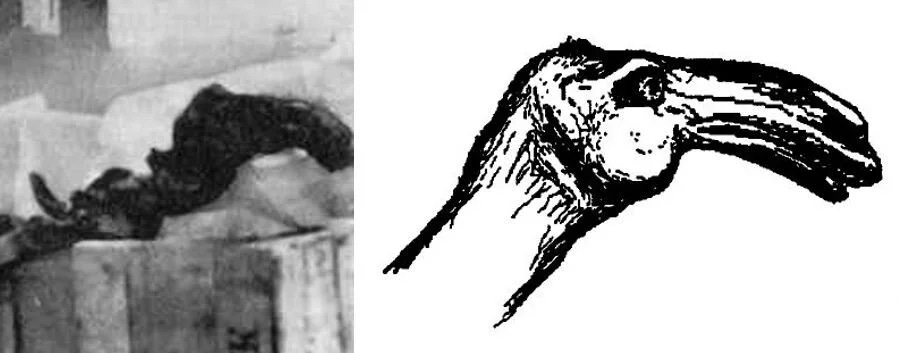
In July 1937 at the Naden Harbour whaling station, located on the northern coast of Graham Island in the Haida Gwaii archipelago, whalers operating at the station were opening the stomach of an adult sperm whale and found something interesting inside. There was a largely intact carcass of an unknown, strange-looking animal measuring approximately 11.5 feet (3.5 meters) in length.
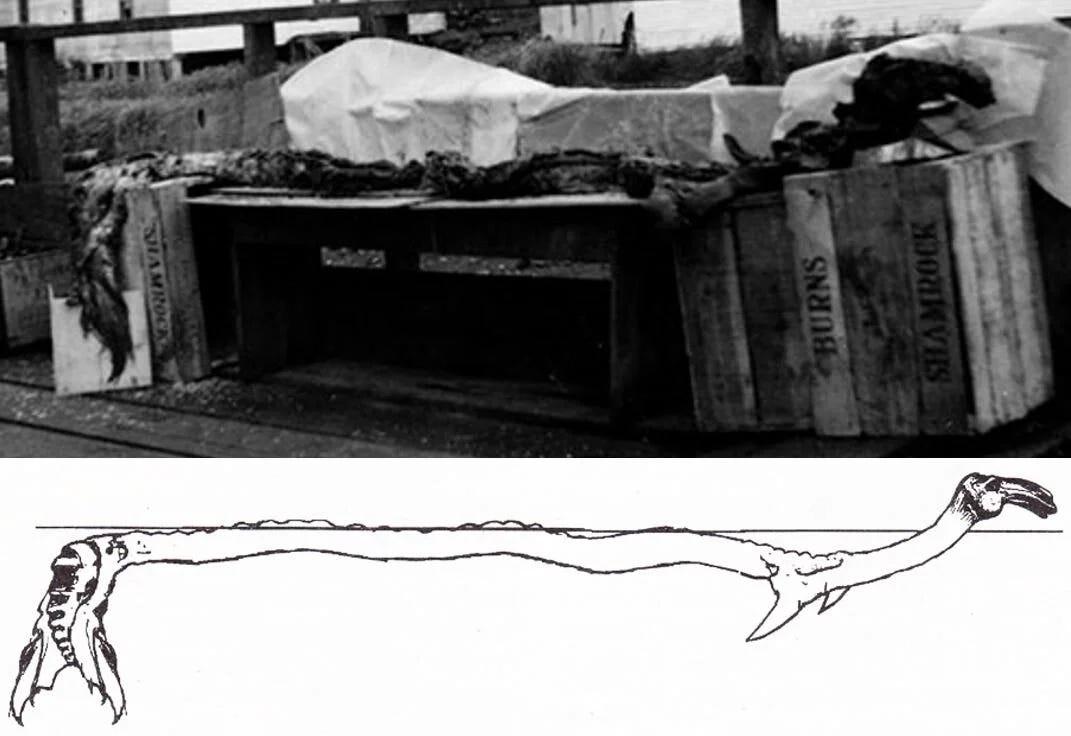
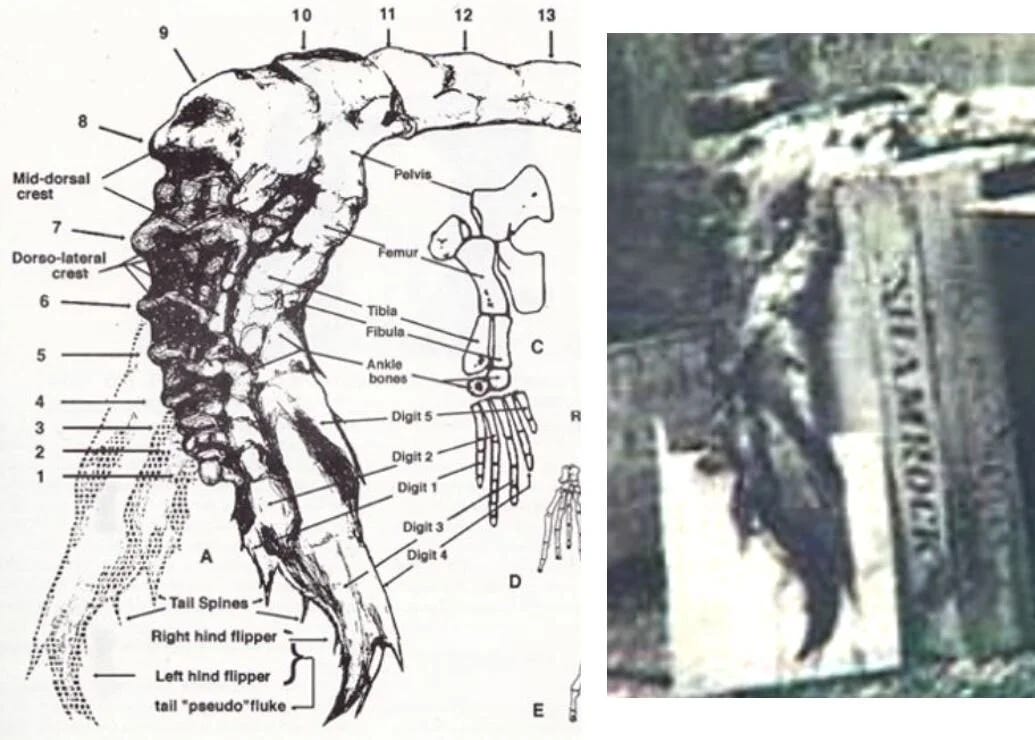
The station’s blacksmith assistant, Jim Wakelen, and the station supervisor, F. S. Huband, noted that the creature looked completely alien. It possessed a head resembling a large dog or camel, a slender serpentine body, a pair of distinct pectoral fins, and a strange, spiny, horizontal tail fluke. Huband laid the carcass across a series of wooden packing crates and photographed it against the wall of the flensing shed.
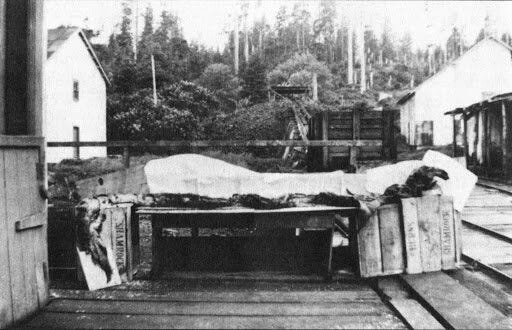
A tissue sample was packaged and shipped south to the British Columbia Provincial Museum in Victoria. However, the museum’s director, Francis Kermode, tentatively identified it as a fetal baleen whale. This identification did not fit the physical morphology in Huband’s photographs. Before independent zoologists could re-examine the remains, the physical specimen vanished, leaving the surviving black-and-white photographs as the only evidence. Decades later, Drs. Bousfield and LeBlond selected one of these images to serve as the official iconographic holotype for their formal taxonomic description of Cadborosaurus willsi. Here are some of their anatomical drawings based on the photographic evidence.
The Owens-Russell Incident (1943)
In 1943, Inspector Robert Owens and Staff Sergeant Jack Russell of the Provincial Police were patrolling the Georgia Strait when they spotted what appeared to be a textbook example of Caddy: a massive, serpentine entity with a horse-like head undulating through the waves.
Sergeant Russell examined the object using high-powered binoculars and determined that it was actually a large, mature bull Steller sea lion leading a tightly packed pod of six smaller sea lions in single-file formation. As the animals dived and surfaced in perfect, synchronized rhythm, their undulating backs created the visual illusion of a single, continuous, 50-foot serpentine torso.
The Hagelund Capture Claim (1968)
In August 1968, William Hagelund, an experienced mariner and author, was anchoring his yacht with his family near De Courcy Island when they noticed a tiny, unusual creature swimming just beneath the surface. Hagelund lowered a canvas dip net and successfully captured a juvenile animal measuring a mere 16 inches (40 centimeters) in length. Hagelund put the animal in a large plastic bucket of fresh seawater to observe it.
It had a slender, eel-like body about the diameter of a thumb, a miniature camel-like head, oversized dark eyes, a pair of small pectoral flippers, and a tiny, horizontal tail fluke. The underside was yellowish-white, while the top was a dark, slate-black covered in fine, velvet-like down or soft hair. It used rapid vertical undulations to swim and displayed a row of tiny, sharp teeth along its lower jaw when approached.
Hagelund intended to bring the specimen to a marine biological station in the morning. However, as the night progressed, the infant’s distress increased, manifesting as a series of soft, clicking noises and erratic swimming patterns. Overcome with empathy for the animal, Hagelund returned to the deck at midnight and released it.
What Might Caddy Be?
Surviving Plesiosaur
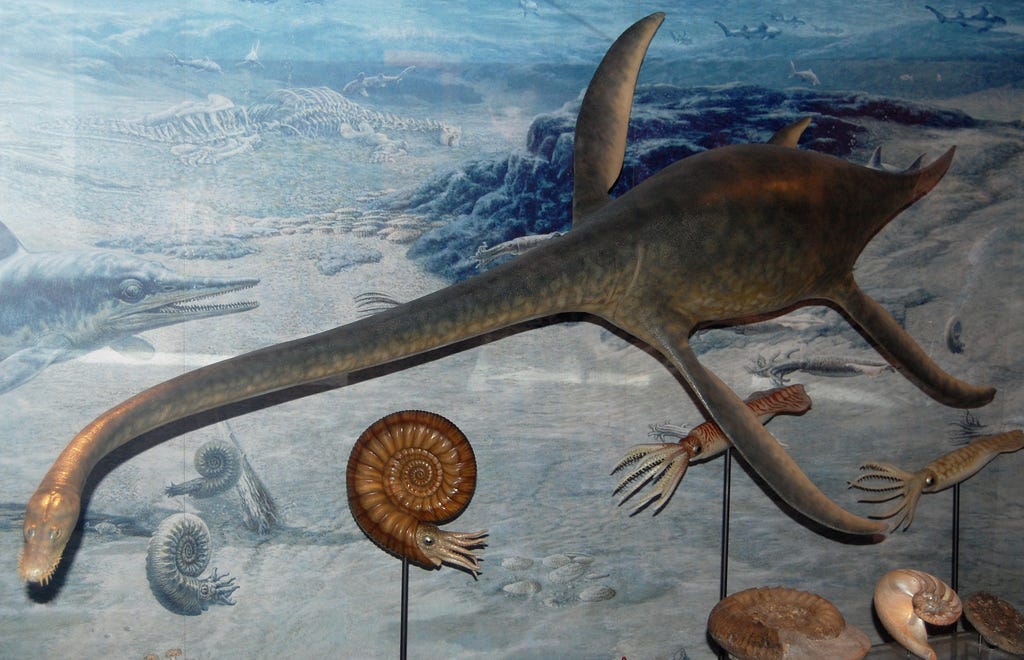
Championed formally by Bousfield and LeBlond in their 1995 classification, this hypothesis suggests that Caddy represents a relict lineage of Mesozoic marine reptiles, specifically an offshoot of the Plesiosauria order or the smaller, ancestral pachypleurosaurs.
This model accounts for the long neck, small head, forward steering flippers, and predatory habits. However, true reptiles are cold-blooded and unlikely to survive in the near-freezing waters of the Pacific Northwest. Also, plesiosaurs used their large flippers for underwater flight and had rigid trunks that could not flex vertically into the multiple surface loops described by witnesses.
Relict Archaeocete
An alternative hypothesis places Caddy within the mammalian lineage as a surviving archaeocete, specifically a member of the Basilosauridae family, which flourished during the Eocene epoch. Basilosaurus was an ancient whale that possessed a remarkably elongated, serpentine body measuring up to 60 feet in length.
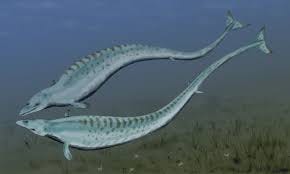
As a primitive cetacean, Basilosaurus retained a flexible spine capable of powerful vertical undulations, possessed a horizontal tail fluke, and had simplified, uniform teeth. This mammalian framework aligns with reports of Caddy’s hair-like pelage, deep-set binocular eyes, warm-blooded tolerance for cold water, and clicking acoustic behaviors. However, The fossil record shows that basilosaurids possessed long, narrow, snake-like skulls with nostrils located midway up the snout, which does not match Caddy’s blunt, squared-off camel head.
Specialized Pinniped
Some cryptozoologists suggest that Caddy may be an entirely unknown, hyper-elongated branch of the Pinnipedia (seals and sea lions). This model proposes a creature that evolved an extreme, eel-like torso to navigate dense kelp forests and narrow rocky channels with high agility.
A giant pinniped would naturally display a mammalian, dog-like or horse-like head, prominent whiskers that look like facial hair, large dark eyes adapted for murky water, and a fish-hunting intelligence. However, an animal that reaches lengths of 50 to 70 feet while remaining narrow enough to undulate vertically would struggle to support internal organs, maintain thermoregulation, and survive the intense physical forces exerted during high-speed marine maneuvers without the dense skeletal support found in cetaceans.
Ichthyological Misidentifications
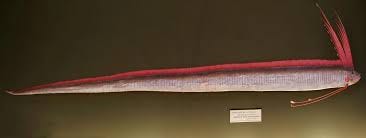
Mainstream marine biologists often argue that Cadborosaurus is a composite myth built on misidentifications of known marine life. The giant oarfish (Regalecus glesne) can reach lengths exceeding 25 feet. It has a ribbon-like, silver body and a bright red dorsal crest that could easily be mistaken for a crimson horse-like mane or a jagged ridge when floating at the surface. However, oarfish swim via lateral ribbons waves and lack any form of flippers, hair, or mammalian snout.
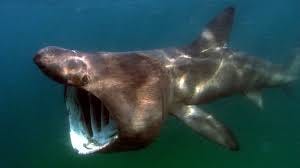
When a massive basking shark (Cetorhinus maximus) dies and decomposes at sea, its lower jaw, gill arches, and lower tail fluke typically slough away first. The remaining spine, small braincase, and pectoral fins create a pseudo-plesiosaur carcass that has fooled people for generations. This process likely explains several historical carcasses found along the coast, though it cannot account for the movements recorded in live sightings.
References & For More Information:
LeBlond, P. H., & Bousfield, E. L. (1995). “Cadborosaurus: Survivor from the Deep.” Horsdal & Schubart.
Heuvelmans, B. (1969). “In the Wake of the Sea-Serpents.” Hill & Wang.
Hill, B., & Hill, R. (1975). “Indian Petroglyphs of the Pacific Northwest.” Hancock House.
LeBlond, P. H., Kirk, J. III, & Walton, J. (2019). “Discovering Cadborosaurus.” Hancock House.
https://qmackie.com/2010/10/07/the-skagit-river-atlatl/
https://tetzoo.com/blog/2020/11/16/cadborosaurus-carcass-review
Coming Up Next
Next in Field Notes from the Beyond: Another installment of Defining the Paranormal.
Who are we?
We are a group of scholars interested in understanding paranormal, supernatural, and anomalous phenomena from an academic perspective. We want to document and validate experiences people have and study them in a rigorous way to bring credibility to these phenomena. Join us for our monthly podcast Beyond the Human and follow us on Spotify, Instagram, and Patreon to learn more about who we are, our methods, and what we want to learn!